Toronto, August 15, 2012. The Spadina Avenue corridor from Bloor to King Streets is a brocade of barriers, hard hats, steel beams and jackhammers, as the TTC’s construction teams retool the streetcar infrastructure to conform to the new trams arriving next year.
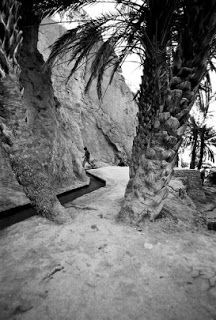
Nine years ago this month I dropped anchor in Tunisia for a six-month contract teaching English at a school in the seaside city of Sousse, packing along with me little besides my old Canon single lens reflex, an 18mm wide-angle lens and a few dozen rolls of Ilford FP4.
I worked six days a week, so when that seventh day came round I was on a bus or a train somewhere into countryside as far as I could get. But it wasn’t till shortly before my departure that I was able to devote an entire week to a voyage into the Sahara, at least to its border towns and not-too-distant oases.
It was a hermetic experience: late May in the foothills of the Atlas Mountains, the Chott el-Djerid salt flats, and beyond them the Sahara — with their mirages, siestas, scorpions and utter lack of tourists — is conducive to isolation and meditation, and I found myself subsisting on a diet of bread, water, the kindness of strangers and contemplations of photography.
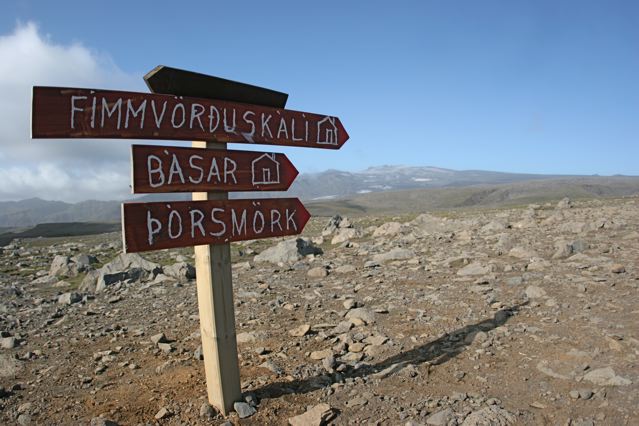
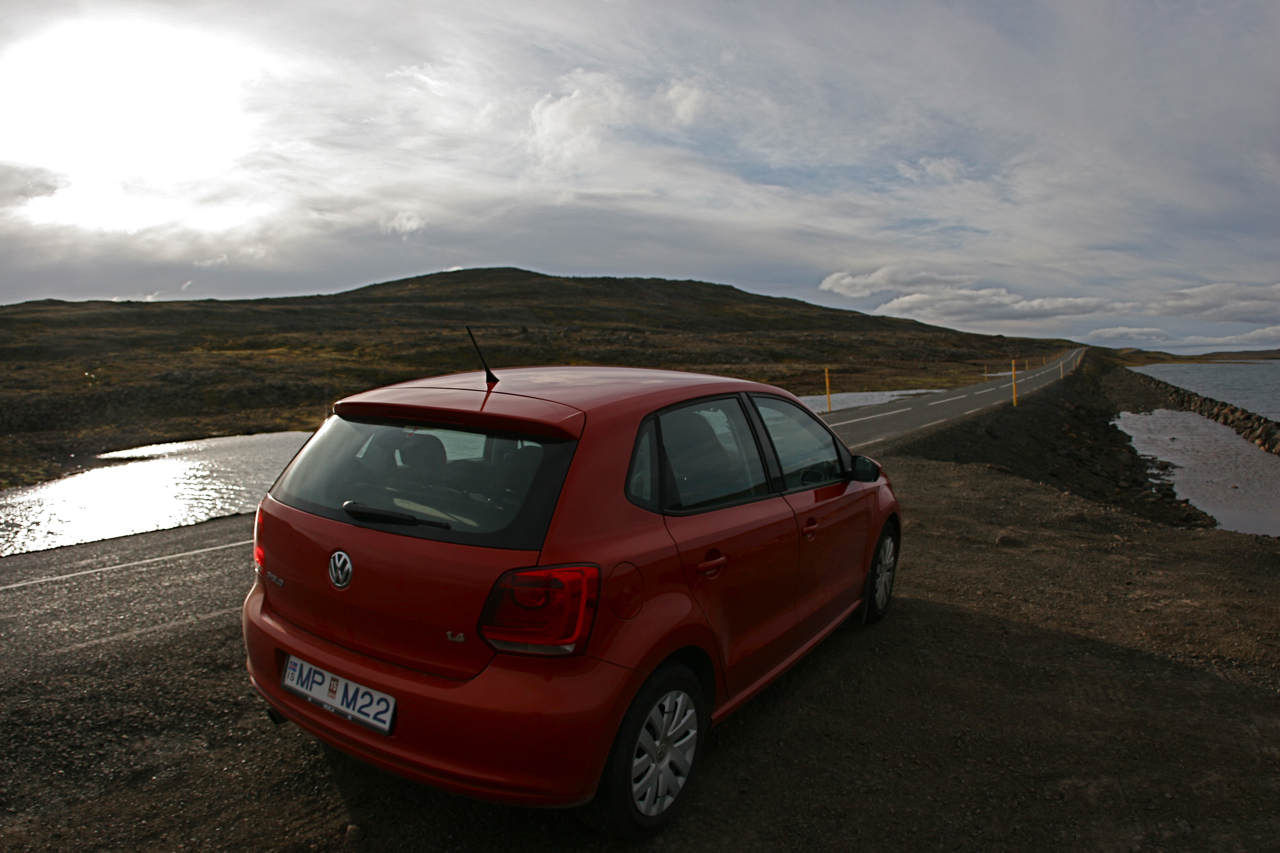
It is possible that the most garrulous person in all of Iceland is a man who spends most of his day alone on a mountain ridge between two volcanoes. Sigurður Sigurðursson is a seasonal warden of a lonely trekkers hut at a place called Fimmvörðuháls, and if you think you can hike up to his domain for a cozy night underneath the aurora borealis without learning how to pronounce Fimmvörðuháls–and without developing an affinity for the Icelandic language–you are sorely mistaken.
It’s simple when you chop it down to the roots, he says (and given the lunar landscape of his realm he’s certainly not talking about trees). Fimm is five. Vörð (pronounced vordh) is cairn. Háls is neck. The Neck of the Five Cairns. That’s where we are.*
It had to be high on the list of places to visit in Iceland: Eyjafjallajökull, the ice cap and eponymous volcano that just a year ago erupted with more fury than a stampede of sheep, spewing clouds of ash across Europe and sending air-traffic controllers on a long-sought holiday (by train, of course).
How could one visit the land of jökulls and not deposit a soft, black footprint on the slopes of this tongue twister (“aye, if yet, la yokel”), if only to ensure that, at least at one particular moment, nature has relaxed its cycle of self-correction long enough for us humans to venture out of our caves?
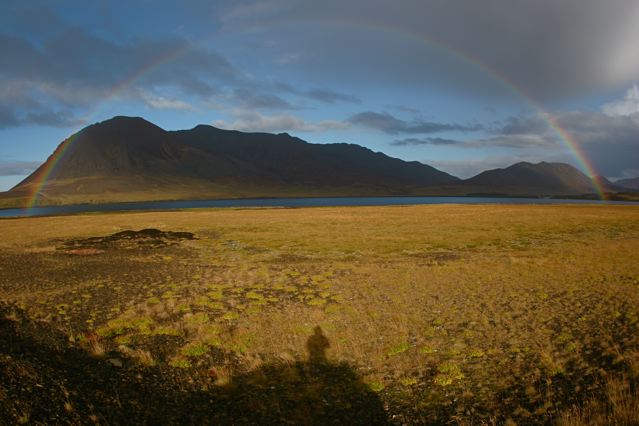
In Iceland the natural world certainly has a way of reminding us not to take it for granted. Maybe it’s the way the sun always seems so distant, at a languid low angle, as though Terrence Malick is in control of the lighting. Maybe it’s in the wind, which blows up, down, warm, cold, east and west, seemingly all at once. Maybe it’s the absence of trees, a taut lesson that what goes down doesn’t always come back up.*
Terrence Malik was here.
Or maybe it’s the way those infamous volcanoes keep all but the most brennevín-sodden of Icelanders (and the rest of us) continually on their toes.
Thus, climbing up and setting foot on Eyjafjallajökull is sort of the human way of letting nature know that, hey, point taken.
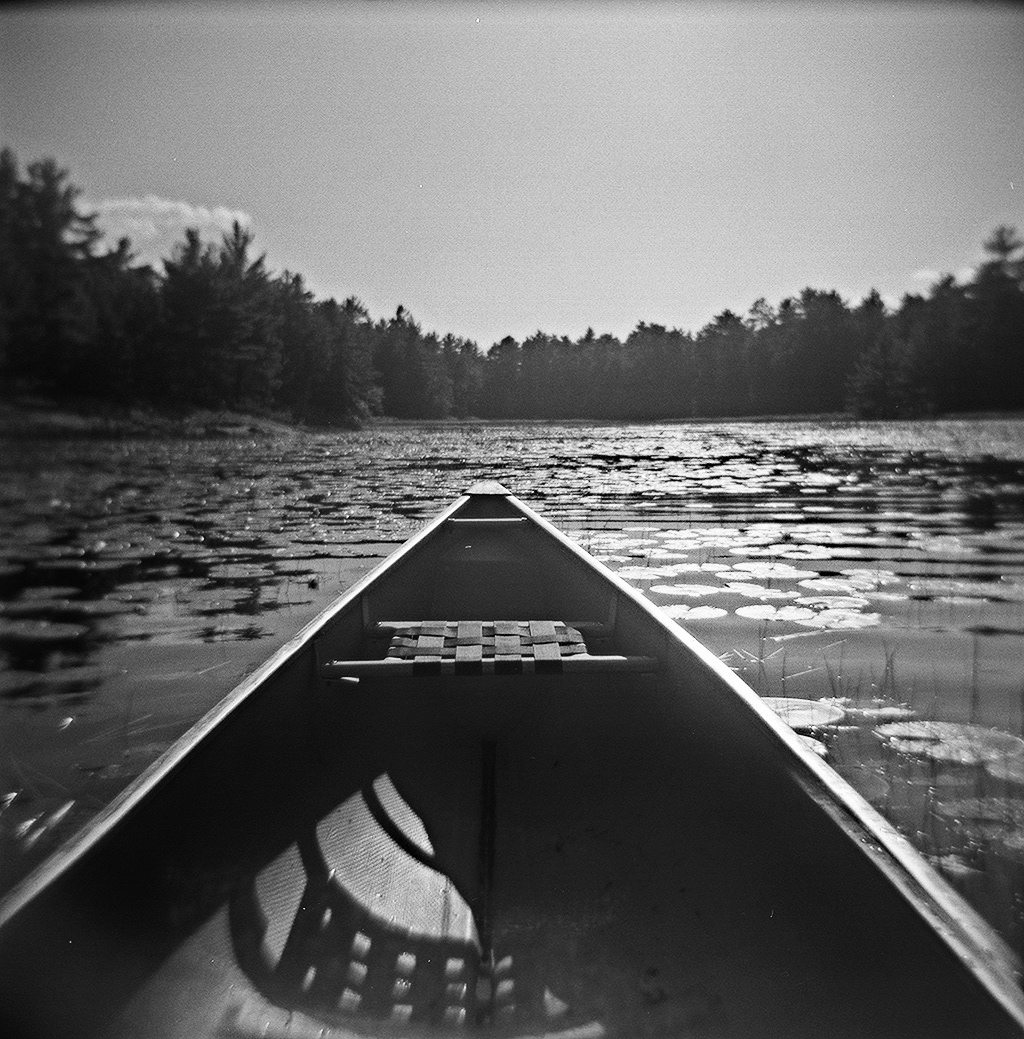
When Samuel Champlain paddled down the Restoule River with a party of Ottawa nation aboriginals in the early seventeenth century, he believed he was beating a trail of discovery to a great, westward river that would lead to the mer de l’ouest, the ocean on the far side of what was, to Europeans, a new found land.
All photographs (c) Richard A Johnson
In the Canada of Champlain’s peers, the frontier emerged from obscurity beneath each footstep and paddle stroke of he and his men. What became known as the French River was the first of many underestimations of Champlain, who was by all evidence one of the more gifted of the early European explorers of North America.
Champlain stood at the confluence of the Restoule and French Rivers and believed the latter flowed over the western horizon to the salted sea. (No doubt his indigenous guides, who may never have come across anything but fresh water during their inland lives, struggled in translation with this alien concept of saltwater.)
Champlain was wrong. But in his wrongness, he made if not a discovery then at least a revelation.
In India I learned most of the local language at the School of Hard Knocks, otherwise known as the vegetable market. Elbowing my way through the horde of pickers, it was:
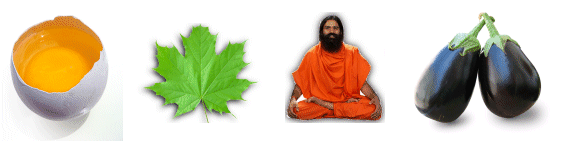
“I’ll take that one, what do you call it?” Brinjal.
“Ach-cha, I’ll take chaari.”*
What do they call them in your country?
“Aubergine. Or sometimes eggplant.”
Egg. Plant?
The vegetable in question is native to southern India, where it was originally known as vatinganah (in Sanskrit). Legend holds that this word, broken up, literally means “fart, go away!” But this ain’t true.
From India the purple perennial travelled west and became badinjāna (Persian) and الباذنجان (al-badhinjān; Arabic). In the 11th century Ibn Sina (aka Avicenna) observed that the badhinjān generates melancholy and obstructions.
In some modern Arabic dialects the word passes the ears as baydhinjān, which sounds like it derives from “egg” (baydh) or “house” (bayt) “of the devil” (ad-djinn).**
The veggie encroached upon Europe from two sides. In the west, Arabic influence led to the Spanish berenjenafrom whence came albergínia (Catalan) and aubergine (Middle French).
After thirteen months in the forests of southwestern Odisha, through the bustling streets of Delhi, across the Himalaya of Sikkim and down the backwater lanes of Kerala, it’s time to come home. An edited anthology of India Travel Writing:
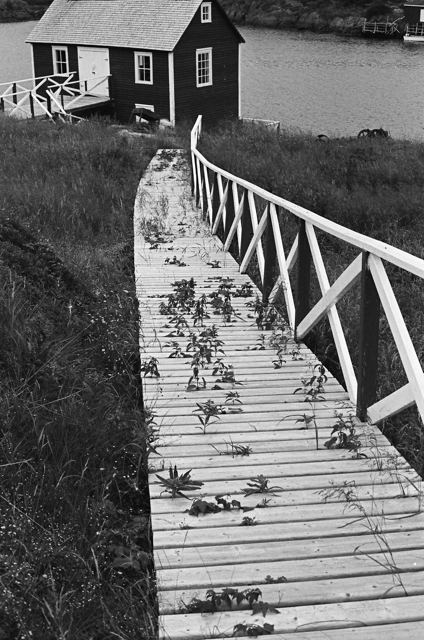
From the confluence of history and myth this remote place draws its name: the earliest inhabitants lived on the North Island during the summer months—in shacks closer to the inshore fishing and squid-jigging grounds—and on the South Island during the winter months—in homes protected from the bitter Arctic winds. Thus, twice per year they would change islands.
Men whose fathers had fished came here to fish; the hamlet of Change Islands was one of the most important outports of the nineteenth- and early twentieth-century Newfoundland fishery, whose annual spring thaw sent sailors “down on the Labrador” to pull cod from the waters all summer long.



 Richard Alexander Johnson